Taste Skill: Turn Design Principles into Interfaces with Taste
Discover how the Taste Skill collection helps AI agents analyze, design, and redesign production interfaces with stronger hierarchy and a distinct point of view.
By OceanSkill · Published
What is Taste Skill?
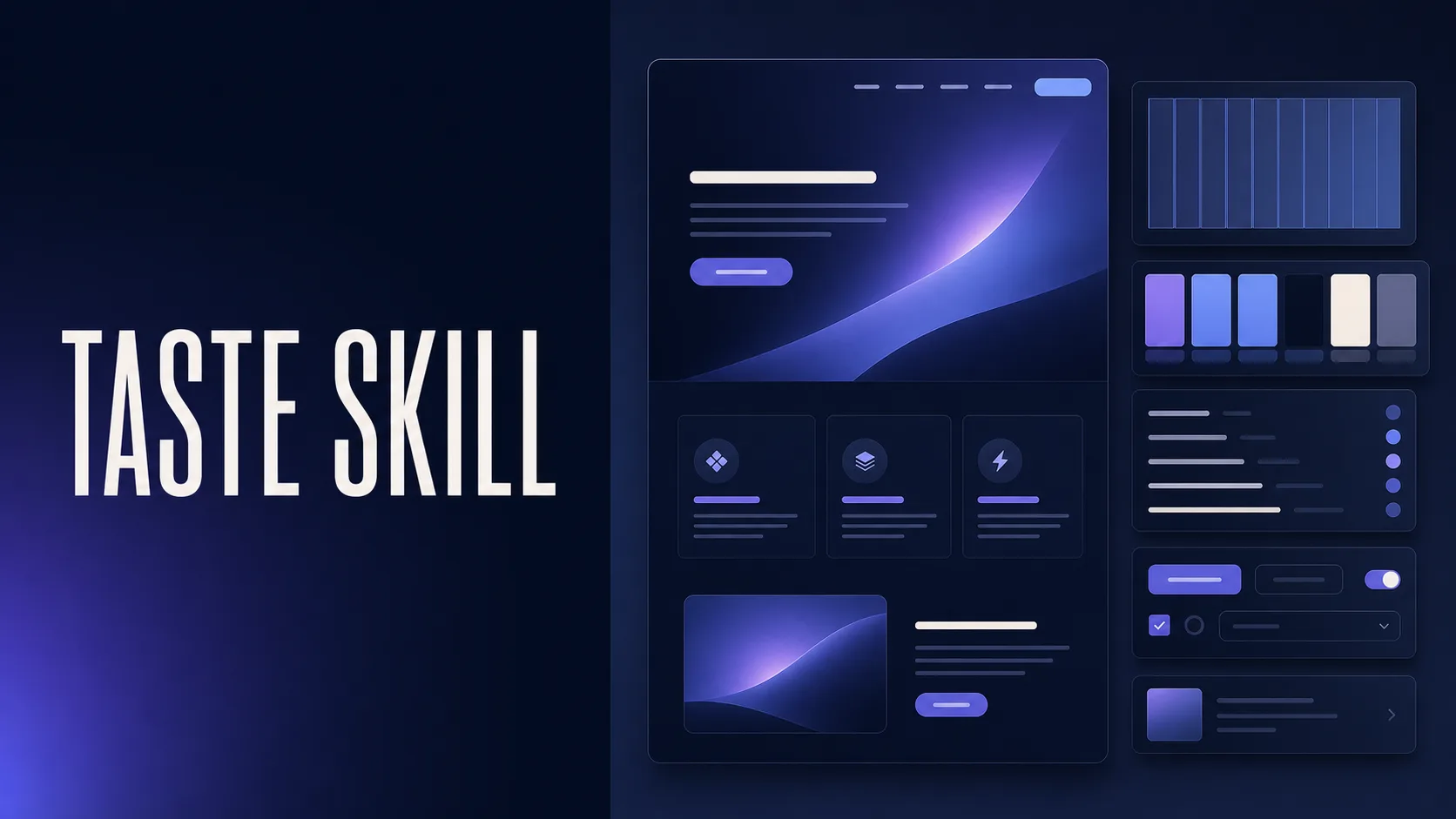
A strong interface needs more than correct functionality. It needs rhythm, hierarchy, breathing room, and a clear reason behind every visual decision. Taste Skill is a collection that helps AI agents move from “building a page that works” to designing an experience with intent.
Instead of producing another generic template, the collection guides an agent to study the product context, identify weaknesses in the current composition, and choose an appropriate design language. The result must remain production-ready while avoiding the familiar patterns that make AI-generated interfaces feel interchangeable.
More than a decoration checklist
Taste Skill is not a request to add gradients, rounded cards, or glow effects everywhere. Its focus is the relationship between content, user behavior, and presentation. A CTA should stand out because it matters. Space should clarify structure. An accent color should work because the surrounding palette is disciplined.
Useful for new builds and existing products
The collection can support a new page, an audit of a live screen, or a redesign of a product with real users. An agent can start from a written brief, an existing frontend codebase, or a screenshot that needs improvement.
The core skills in the collection
Taste Skill GPT: establish direction before designing
Taste Skill GPT helps an agent clarify the objective, audience, brand character, and quality bar before writing interface code. This is especially valuable when the original prompt is short or contains several competing goals.
Rather than choosing a style immediately, the agent identifies the primary information, the most important action, and the feeling the product should create. Those decisions become the foundation for typography, color, information density, and motion.
Taste Skill Redesign: improve without erasing the product
Taste Skill Redesign focuses on interfaces that already exist. It helps an agent find weak hierarchy, repetitive cards, inconsistent spacing, competing CTAs, and dark and light themes that do not feel like one system.
The goal is not to replace everything with a new concept. The agent should preserve structures and behaviors that already provide value, then improve the parts that make the experience unclear or anonymous.
A practical workflow
Step 1: provide context and define the outcome
Tell the agent who the product serves, what the screen should help users accomplish, and which elements must remain unchanged. Include a design system, brand guide, or visual references when they are available.
Step 2: request an analysis before implementation
A useful redesign begins with a diagnosis. Ask the agent to identify issues in hierarchy, typography, color, spacing, responsiveness, and accessibility. This list lets you verify that the implementation solves real problems instead of merely making the screen look different.
Step 3: implement and verify both themes
Once the direction is clear, the agent can update components, tokens, and layout. Review desktop and mobile, dark and light mode, and the hover, focus, loading, and empty states that users encounter in production.
When should you use Taste Skill?
Taste Skill is useful when a site works but still feels safe, repetitive, or without a distinct point of view; when a product contains screens created at different times; or when you want an agent to follow a design process that can be explained and verified.
Start with the OceanSkill collection
Explore the available skills, add the collection to your library, and use it through MCP from the Taste Skill platform collection. Start with one small screen, compare the before and after states, and then extend the rules across the product.
OceanSkill
Discover how the Taste Skill collection helps AI agents analyze, design, and redesign production interfaces with stronger hierarchy and a distinct point of view.